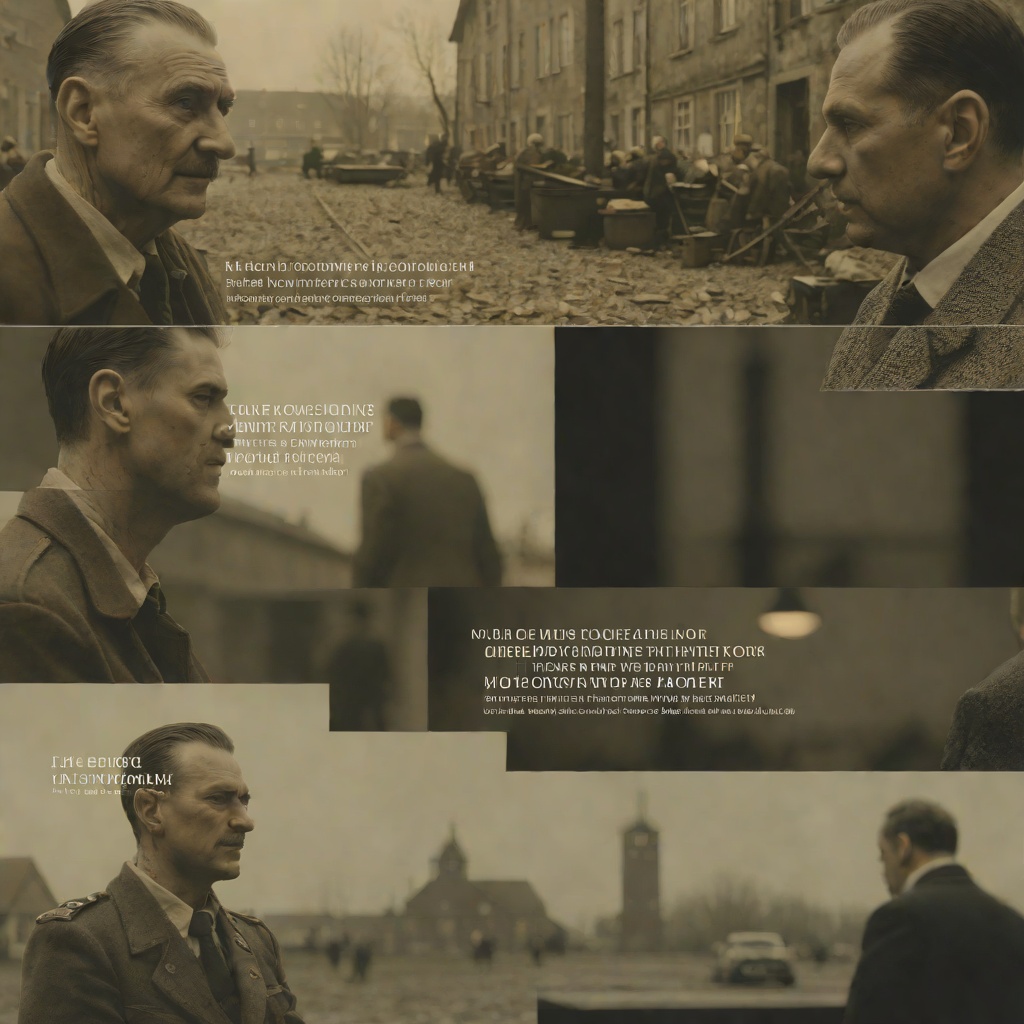
Lale and Oberscharführer Houstek's relationship
The Tattooist of AuschwitzThe relationship between Lale Sokolov and Oberscharführer Houstek is one of the defining power dynamics of the Auschwitz narrative, a precarious bond forged in the shadow of the gas chambers and sustained by a mixture of professional utility, mutual suspicion, and the ever-present threat of violence. Houstek, the SS officer who oversees the tattooing operation, is the man who grants Lale his role as the Tätowierer, and the man who later orders his torture and near-execution. Their interactions trace the arc of Lale's survival from his first day in the camp to the final, ambiguous restoration of his position, revealing the capricious nature of SS authority and the moral tightrope a prisoner must walk to stay alive.
The First Encounter and the Gift of the Job
Lale's introduction to Houstek occurs within the chaos of the selection process at Birkenau, where hundreds of new prisoners are being sorted into those who will live and those who are the walking dead. As Lale stands frozen, watching the SS and their dogs shepherd the terrified boys like lambs to the slaughter, Pepan, the camp's tattooist, guides him to a table with tattooing equipment. A shot rings out, a man falls, and Pepan grabs Lale's face to twist his head away from the horror. It is in this atmosphere of arbitrary death that a group of SS officers, mostly young, approach, guarding an older officer. Lale immediately sizes him up: mid-to-late forties, straight-backed in his immaculate uniform, his cap sitting precisely on his head—a perfect mannequin, Lale thinks, like those he occasionally helped dress when he worked in the department store in Bratislava.
Pepan steps forward, acknowledging the officer with a bowed head, and introduces Lale as a prisoner he has enlisted to help. Houstek turns his steely gaze on Lale, wagging a finger for him to step forward. The first test is linguistic. When Houstek asks what languages he speaks, Lale answers, looking him in the eye, "Slovak, German, Russian, French, Hungarian, and a little Polish." Houstek responds with a mere "Humph" and walks away, leaving Lale to wonder if he has the job. Pepan's reaction is immediate and fierce: "Do not underestimate him. Lose your bravado, or you will lose your life. Next time you talk to him, do not raise your eyes above the level of his boots." This warning defines the terms of the relationship from the outset—Houstek is not a man to be trifled with, and Lale's natural confidence is a liability in his presence.
The Fragile Privilege of the Tätowierer
The precariousness of Lale's position becomes clear several weeks later when he reports for work and finds his table and equipment already laid out, but no sign of Pepan. Instead, Houstek approaches, accompanied by a young SS officer, and mumbles, "You will be working alone today." When Lale dares to ask where Pepan is, Houstek stops, turns, and glares back at him, and Lale's heart skips a beat. The question is a breach of protocol, a reminder that the Tätowierer's role is a privilege that can be revoked at any moment. The fate of Pepan is never explained, but the implication is clear: no one is indispensable, and the SS answer to no one.
The relationship is further tested during a selection overseen by Houstek, where Lale and Leon are tasked with tattooing the new arrivals. Leon, exhausted and stumbling, is tormented by Stefan Baretski, who trips him repeatedly on the walk back to Birkenau and then, at the selection, hits him with his rifle and presses his boot into his back. Lale intervenes, telling Baretski, "We can get the job done faster if you let him pick himself up and get on with it." Houstek bears down on the three men and mumbles something to Baretski, who, with a sour smile, pushes his foot down hard on Leon's body before releasing it. Baretski then delivers a chilling speech to Lale, explaining the hierarchy: "I am just a humble servant of the SS. You, Tätowierer, have been placed under the auspices of the political wing, which answers only to Berlin. It was your lucky day when the Frenchman introduced you to Houstek and you told him how clever you are, speaking all those languages." The exchange reveals the complex web of authority in which Lale is caught—he is protected by Houstek's patronage, but that protection is contingent on his usefulness and his obedience.
The Interrogation and the Fall
The relationship reaches its crisis when Lale is arrested and brought before Houstek with the contents of his bag—precious stones and pieces of jewelry—spread out over the Oberscharführer's desk. Houstek picks up and examines each item, one at a time, asking where Lale got them. Lale claims that prisoners gave them to him, but he does not ask their names. Houstek slams his fist on the desk, causing the gems to jangle, and declares, "This makes me very angry, Tätowierer. You are good at your job. Now I will have to find someone else to do it." He orders Lale taken to Block 11, where he will "soon remember the names." The drive to Block 11 is a journey of farewell: Lale silently says goodbye to Gita and the future they were imagining, mentally recites the names of his family members, and struggles to picture his siblings, though his mother he can see perfectly. He cannot say goodbye to her, and he gasps as his father's image comes before him, causing one of the officers to push his pistol harder into his ribs. He searches for a better memory of his father, finding him working with his beloved horses, speaking warmly to them in contrast to how he expressed himself to his children. He thinks of his brother, Max, older and wiser, hoping he hasn't let him down, and of his little sister, Goldie, whose memory is too painful to bear.
In Block 11, Lale endures torture, but he does not break. When he is finally dragged back into Houstek's office, the officers report, "We got nothing out of him, even after the big Jew had a go." Houstek turns to Lale, who raises his head, and asks, "So you really didn't know their names? And the officers didn't shoot you?" Lale confirms, and Houstek, seemingly resigned, says, "And now they've returned you to me. Now you're my problem again." He orders Lale taken to Block 31, adding, "We will get some hard work out of you before your number is up, mark my words." The scene is a study in the arbitrary exercise of power: Houstek could have had Lale shot, but instead he chooses to keep him alive, to extract what use he can from him. The welts across Lale's back and buttocks, revealed when the inmates of Block 31 try to help him, are the physical evidence of the cost of his defiance.
The Ambiguous Restoration
Lale's return to his role as Tätowierer is not a simple act of mercy on Houstek's part. When Lale is told he can have his job back, he asks, "Houstek is letting me have my job back?" The answer is a revelation: "I wouldn't go anywhere near him. He didn't want you back; he wanted you shot. It was Schwarzhuber who had other plans for you." Houstek's hostility is undiminished; it is only the intervention of a higher authority, Schwarzhuber, that saves Lale. The warning that follows—"Tätowierer, don't. You will be watched very closely"—makes clear that Lale's reprieve is conditional and that his every move will be scrutinized. The relationship thus ends not with reconciliation but with a tense, watchful truce, in which Lale's survival depends on his continued usefulness and his ability to avoid provoking the man who wanted him dead.
The Thematic Significance of the Relationship
The relationship between Lale and Houstek is a microcosm of the moral compromises and arbitrary violence that defined life in Auschwitz. Houstek is not a cartoonish villain but a bureaucrat of death, a man who can casually order a prisoner to Block 11 and just as casually return him to work. For Lale, the relationship is a constant reminder of his own precarious position: he is a prisoner whose life is spared only because he is useful, and whose usefulness is always one misstep away from being revoked. The dynamic also highlights the ethical dilemmas of survival—Lale's role as Tätowierer, marking prisoners with numbers, is itself a form of complicity, and his relationship with Houstek is the price of that complicity. Yet within this compromised position, Lale finds ways to resist, whether by protecting Leon from Baretski's cruelty, by refusing to name the prisoners who gave him the jewels, or by using his position to help others, as when he changes Mendel Bauer's number into a snake to conceal it before Mendel is sent on a transport. The relationship with Houstek is thus not merely a personal conflict but a structural one, embodying the tension between survival and humanity that runs through the entire narrative. Houstek's final, grudging acceptance of Lale's return, and his warning that Lale will be watched, leaves the reader with a sense of unresolved danger, a reminder that in the camp, no relationship is ever truly stable, and no prisoner is ever truly safe.